Purposeful planning to foster the chaos of creativity
Caldwell Organized Chaos
Home Teacher Mommy Shop Pinterest YouTube Instagram Facebook Blog Home

Tuesday, March 22, 2022

(more) YouTube Channels for Elementary Music

Back in 2016 I wrote a post sharing my top 3 favorite YouTube channels to use in my elementary music classes (I'll link it at the end of this post if you're curious). Since then things have... cough... changed a bit, and I think YouTube is officially a part of a lot more music classrooms than it was back then! With the explosion of digital resources I've discovered plenty of new favorites, so today I'm sharing 3 more channels I find myself returning to over and over.
1. Andrew Huang

Where do I begin? Andrew Huang is my hero. He has so much great content! Whether it's exploring genres with videos like this, inspiring my older kids to sing with this awesome video, or even tutorials on tons of music theory and music production topics, there is a lot that can be used with a broad range of ages on a huge variety of lesson topics. The ones I use the most are his amazing found sound videos (many of them are in this playlist), but my all-time favorite video has to be this one, which I use when we are getting ready to review the notes on the treble clef:


2. Ready GO Music

We all know the internet is full of rhythm play along videos now, but Ready GO Music is my go-to channel for the best ones. They are always lined perfectly with the beat, the rhythms show up before they are supposed to be played so you can look ahead, and there are so many different seasonal themes and different levels with different rhythm elements. My favorite ones are the duet versions, like this one:


3. Mr. Henry's Music World

This one is a recent discovery but his videos have saved me when I was making sub plans on multiple occasions! He has some nice rhythm play alongs, like this Wellerman one that my upper elementary classes loved, and even some different tutorial videos for everything from piano to recorder to music theory, but the ones that I found were perfect for sub plans are the ones he has made that go smoothly between body percussion, note reading, movement, and singing/ chanting with different seasonal themes. This video was perfect for 2nd graders to review half notes and form when I was out one day in December:


This is one of those posts where I know I will be kicking myself later for not thinking of that other great channel I love, or that one that I should have shared too, but in the interest of brevity we'll stop there for now and put it to you in the comments section: which channels do you use most in your elementary music lessons? Maybe we'll have to do a part 3! If you want to see my top channels from 2016, you can see that post here.

Tuesday, March 15, 2022

Female Musicians for Women's History Month (and beyond)

I honestly have never been intentional about doing anything to specifically recognize Women's History Month in my classroom because it falls at the same time as Music In Our Schools Month, but I have been making a conscious effort for years to make sure female musicians of all types are represented in the examples I share, and this year I have been working with my district music department team to highlight some female artists this month. Here are just a few of my favorites to highlight with elementary and middle school students!

1. Germaine Franco

She wrote the score for the movie "Encanto" and was recently nominated for an Academy Award.


She is a prominent percussionist from Scotland who is also hard of hearing.


She is currently the conductor of the Seattle Symphony, and the New Jersey Symphony Orchestra before that.


She was a Cuban American singer often called the "Queen of Salsa".


She is a hip-hop producer who has worked with Mariah Carey, Drake, Jay-Z, and many other artists.


Of course there are hundreds of other amazing female artists that would be excellent examples to feature- if you have more favorites please leave them in the comments! Besides just featuring female musicians, there is a lot we can do to respect, reflect, and respond to the needs of our female students- you can read my previous post with more thoughts on that here.

Tuesday, March 8, 2022

Dear Everyone: Stop Calling Us "Specials".

Happy Music In Our Schools Month! If you know me well you know I am an idealist. I may sometimes go overboard caring a little too much about issues that don't truly need to be that big of a deal. And when it comes to music education advocacy, I am more fired up than ever during the month of March! But as much as people may want to roll their eyes at me I want you to hear me out: language matters. Labels matter. We need to change the terminology we use to refer to different types of elementary teachers and staff. 

In case you're not familiar with the US elementary school world, here's a brief summary of common terminology I hear:

  • "classroom teacher" refers to elementary teachers who teach multiple subjects to one group of children all year- a Kindergarten teacher, or a 4th grade teacher.
  • "specials teacher" refers to teachers who teach one subject to multiple groups of children- usually every class in the school- a music teacher, or a PE teacher.
I didn't have as big of an issue with the term "specials" when I started teaching. As I understand, the term came to be used not because our subject areas are "special" but because we, the one-subject teachers, "specialize" in a subject (unlike the 3rd grade teacher who teaches multiple subjects). But the reality is nobody thinks of it that way when they use the term "specials", and more and more it started to bother me the way the term perpetuated the idea that certain subjects were frills, not "core" subjects, and therefore disposable if budgets were too tight.

In an ideal world (here we go with ideals) I would love to just get rid of the constant need to distinguish between teachers and classes. There is already so much toxic perceived hierarchy within elementary staff, why not just call everyone exactly what they are (music teacher, 2nd grade teacher) and our classes exactly what they are (computer class, 5th grade class) and be done with it? But I know, the reality is sometimes there is a need to put us into categories, and listing out every single specific job title is way too tedious. 

Here's the best solution I've come up with to improve clarity of language and remove stigmatized terminology from our collective vocabulary:

  • "classroom teacher" should refer to anyone who teaches a class(es) as a group (art teacher, 1st grade teacher), to distinguish from teachers and staff who teach pull-out groups etc (social worker, speech language pathologist, instrumental music pullout lessons teacher)
  • "homeroom teacher" should refer to anyone who specializes in an age group rather than a subject area and teaches one group of students multiple subjects for the majority of those students' day (Kindergarten teacher, 5th grade teacher)- I prefer this over "grade level teacher" only because there are multi-age classes in some districts that would fall in this category
  • for teachers who specialize in a subject area but teach multiple whole classes (general music teacher, art teacher), I prefer an acronym that includes all the subjects taught. It works out conveniently for us in our district, since we have library media, art, music, and PE, to use the term "LAMP teacher". If a school had computer class in addition to those, the term could be "CLAMP", for example. 
I think it's important to expand the traditional definition of the term "classroom teacher" to include all teachers who teach whole classes, to subtly shift to the mindset that they are all classes and not "core classes" vs "extracurriculars" or "frills". I also think we need to move away from any variation of the word "special" to refer to any classroom teachers or classes because of the stigma it has undeniably created. Dropping those terms also allows for more clarity for districts like mine that have "specialists" who primarily work in teacher coaching, curriculum writing, etc like a math specialist or literacy specialist- save the "special" for them.

I know this may cause some controversy- I'm sure there are music teachers who don't have a problem with the term "specials" and don't feel they are treated like second class teachers in their buildings, and I'm sure there are many others who just don't think it's that big of a deal, or that changing our language will change the hierarchical treatment of elementary teachers and stigma against certain subjects. But we need to all get on board with this for the greater good, even if you don't perceive a negative impact in your specific building, and we have seen time and time again that our words do matter and the language we choose does affect our thoughts and perceptions and the thoughts and perceptions of the people who hear us. 

Stop calling us specials.

Tuesday, March 1, 2022

Melody Match: a new game for Music In Our Schools Month®

Happy Music In Our Schools Month® (MIOSM®)! I love celebrating music in my classes with different games that can be repeated all month and challenge students to improve their scores (and covertly drill important music skills). Since my first year of teaching well over a decade ago I've been doing 2 games, Rhythm Battle and Disco Duel (described in this post) for MIOSM, but I've always wished I had something similar to practice melodic concepts. Last year I finally came up with something I like, and it's so easy to add to your lessons! 

This is nothing revolutionary... The basic idea of Melody Match is to see how many note letter names the class can identify in one minute. Depending on the grade it might be just treble clef on the staff, adding ledger lines, or treble and bass clef- this could even be done with solfege. A note comes up on the screen and I call on 1 student to name the note. They get one chance- if they're right the class gets a point and I pull up a new note, if they're wrong I go to the next student and continue until they get it right (or the timer ends). The total number of notes they identify correctly in one minute is their class score for that day, and they try to improve their score each time they have music class during the month of March (you could also do this like the way I run Rhythm Battle, and make it a competition between classes within each grade to see which class can get the highest total score). 

The key to this game is MusicTheory.net. If you haven't ever used this site as a music teacher, it is a goldmine! But what many teachers may not know is that you can customize exercises, and that's what I use for this game. If you aren't familiar with how to customize exercises, here's a quick tutorial:


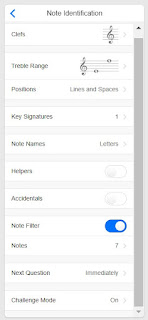
For this particular game, the key setting to use is "challenge mode"! This allows you to set a timer of one minute (or whatever amount of time you want to give them) in the game so you don't have to keep track yourself. For example if I'm doing the simplest treble clef version, these are the settings I use:


These are the links for the different versions I've set up for my students (all with 1 minute timers): treble clef on the staff, treble clef from middle C to high A above the staff, and treble and bass clef on the staff. There are endless ways to adjust these for different games to practice pitch names! 

I'm so excited to have this game to add to our celebrations this year. It's quick and easy but it gives the students some great practice and it's fun! To see all of my ideas for celebrating Music In Our Schools Month, click here. 

Hi, I'm Elizabeth

A mom to twin girls, elementary music teacher, and planner lover. I help music teachers embrace the chaos of creativity through purposeful organization.

Visit the Shop

Classroom-tested music resources, made by a real music teacher.

Browse the Shop
© Organized Chaos. All rights reserved.